Starbucks Unsweetened Matcha: What the 2025 Change Means Now
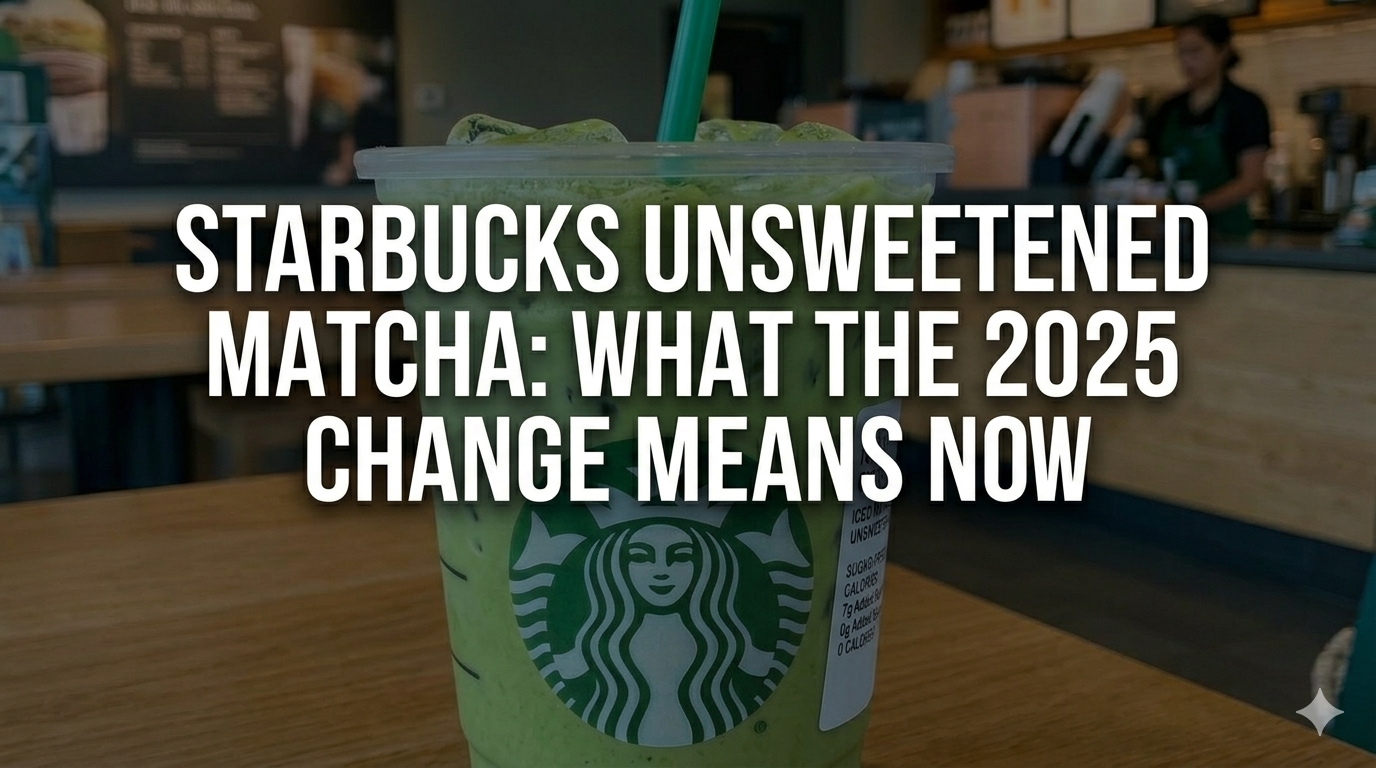
The Starbucks unsweetened matcha switch that rolled out on January 2, 2025 is one of the most significant recipe changes the chain has made in years — and most customers still don’t fully understand what it actually means for their drink. For over a decade, Starbucks used a pre-sweetened matcha powder where sugar was literally the first ingredient, making it impossible to order a truly unsweetened matcha drink no matter how you customized it. Now that the powder is pure, shade-grown green tea with no added sugar, the entire calorie and macro profile of every matcha drink on the menu has fundamentally shifted. This guide breaks down exactly what changed with Starbucks unsweetened matcha, what stayed the same, and what it means for your calorie calculator — so you never get caught out by a number that’s no longer accurate.
What Is the Starbucks Unsweetened Matcha Change — and When Did It Happen?
Starbucks officially switched to unsweetened matcha powder on January 2, 2025, as part of a broader quality overhaul under CEO Brian Niccol’s “Back to Starbucks” initiative. The old formula — used for years across U.S. locations — was a blend where sugar was the primary ingredient, comprising roughly 50% of the powder’s total composition. That meant every scoop of matcha added not just green tea flavor but also a significant and unavoidable sugar load directly baked into the ingredient itself. A standard Grande Iced Matcha Latte made with 2% milk and three scoops of the old sweetened powder contained approximately 32 grams of sugar — a figure comparable to a similarly sized soda.
The new unsweetened powder changes all of that. It is pure, shade-grown green tea sourced from some of Japan’s oldest tea-growing regions — the same kind of high-quality matcha that has always been the standard in traditional Japanese tea preparation. Starbucks officially confirmed the change in a February 2026 press release, noting that it was introduced in direct response to years of customer feedback requesting a more authentic and customizable matcha experience. The new powder contains no added sugar at all, meaning the sweetness of your drink is now entirely determined by what you choose to add — not by what was already mixed into the base ingredient.
The Critical Detail Everyone Gets Wrong: Your Drink Is Still Sweet by Default
Here’s where the confusion lives — and it’s important. Just because Starbucks switched to unsweetened matcha powder does not mean your matcha latte is now unsweetened. When the new powder launched, Starbucks simultaneously updated its standard recipe so that all matcha beverages are made with Classic Syrup added by default. A barista confirmed on Starbucks’ official Threads account: “The matcha powder itself is now unsweetened, and we automatically add classic syrup. So you can customize the sweet level and ask for no classic to make it truly unsweet.”
This means if you walk up to the counter and order a standard Grande Iced Matcha Latte without any customization, you will receive a drink made with unsweetened powder plus Classic Syrup — which typically adds around 15 grams of sugar from three pumps of syrup at the Grande size. The drink is still sweet. It’s just sweet in a different, more controllable way now. The crucial shift is that sweetness has moved from being locked inside the powder to being a variable you control at the time of ordering. That is genuinely significant — but only if you know to ask for it.
Before vs. After: How the Calories and Sugar Actually Changed
To understand the real-world impact on your calorie tracker or nutrition calculator, it helps to compare the old and new formulas directly. Under the old sweetened powder formula, a Grande Hot Matcha Latte with 2% milk came in at approximately 240 calories with 32 grams of sugar — roughly 13 grams of which came from the three scoops of sweetened powder alone, with the rest coming from the milk. The powder contributed about 13 calories and 4.5 grams of sugar per scoop, so a three-scoop Grande added 39 calories and 13.5 grams of added sugar purely from the powder, before any syrup or milk entered the equation.
Under the new unsweetened powder formula with default Classic Syrup, the calorie count at Grande size is similar on a standard order — because the sugar that used to come from the powder has been replaced by sugar from the Classic Syrup. However, the critical difference is customizability. With the old formula, you could not meaningfully reduce the sugar regardless of how you ordered. With the new formula, you can ask for no Classic Syrup and receive a drink with zero added sugar — just the natural sugars from whatever milk you choose. A Grande Iced Matcha Latte with oat milk and no Classic Syrup now comes in at roughly 130–150 calories with no added sugar. That simply was not possible before January 2025.
What This Means for a Starbucks Calorie Calculator
For any tool that calculates Starbucks matcha drink calories — including third-party apps, nutrition trackers, and dedicated Starbucks calorie calculators — this change created a significant data accuracy problem that is still being corrected across the internet. The calorie math for matcha drinks changed fundamentally because the sweetener source changed. Any calculator that was built on the old “per scoop of sweetened matcha powder” model needs to be updated to reflect two things: first, the new unsweetened powder has a dramatically lower calorie and sugar count per scoop; and second, the Classic Syrup is now a separate, adjustable variable that should be calculated independently based on the number of pumps added.
In practical terms, a scoop of the old sweetened matcha powder contributed approximately 13 calories and 4.5 grams of sugar. A scoop of the new unsweetened matcha powder contributes roughly 3–5 calories and 0 grams of added sugar. The difference per scoop is small in calorie terms but enormous in sugar terms. Multiply that across three scoops in a Grande and you’re looking at a reduction of approximately 12–14 grams of added sugar from the powder alone — even before you account for the ability to reduce or eliminate the Classic Syrup. Any calorie calculator that still reflects the old sweetened powder formula is understating the flexibility of the current menu and potentially overcounting the sugar content of unsweetened customizations.
How to Order Starbucks Matcha in 2026: The Complete Customization Guide
Understanding the new unsweetened matcha base means you can now approach your Starbucks matcha order with genuine precision. Here are the key ordering scenarios and what they deliver nutritionally at Grande size.
Standard Order (Unsweetened Powder + Default Classic Syrup)
This is what you get if you simply order a “Grande Iced Matcha Latte” without any customization. You receive three scoops of unsweetened matcha powder, 2% milk, ice, and three pumps of Classic Syrup — resulting in approximately 200–220 calories and around 28–32 grams of total sugar (mostly from milk and syrup). This is very close to the old formula in terms of sweetness and calorie count, which is by design. Starbucks wanted the transition to be seamless for customers who don’t actively customize their orders.
Reduced Sugar Order (Unsweetened Powder + Fewer Syrup Pumps)
Ask for one or two pumps of Classic Syrup instead of the default three, and you reduce the added sugar by approximately 5–10 grams and save around 20–40 calories. This is the easiest way to make a meaningful nutritional improvement without changing the fundamental taste experience of the drink. Most customers who try the two-pump version find it still tastes sweet enough, especially when paired with oat milk or almond milk which add their own subtle sweetness.
Truly Unsweetened Order (Unsweetened Powder + No Syrup)
Say “no classic syrup” explicitly when ordering, and your matcha drink will contain zero added sugar. The only sugars present will be naturally occurring ones from whatever milk you select. A Grande Iced Matcha Latte with oat milk and no classic syrup lands at approximately 130–150 calories with around 13–15 grams of natural sugar from the milk. With almond milk, it drops further to roughly 80–100 calories. This is a genuinely low-calorie, no-added-sugar drink that tastes of clean, earthy green tea — and it was completely unavailable before January 2025.
Sugar-Free Sweetened Order (Unsweetened Powder + Sugar-Free Vanilla Syrup)
For customers who want some sweetness but zero added sugar, replacing Classic Syrup with Sugar-Free Vanilla Syrup is the ideal solution. Sugar-Free Vanilla Syrup uses sucralose instead of cane sugar, contributing 0 grams of added sugar at any pump count. This creates a drink that tastes sweet and smooth but keeps the added sugar at zero — an option that was entirely theoretical under the old sweetened powder formula.
The New Matcha Menu in 2026: More Drinks, More Variables
The switch to unsweetened matcha powder didn’t just change the existing latte — it opened the door to an expanded matcha platform that Starbucks has been building aggressively since early 2025. As of February 2026, the matcha lineup has tripled from four drinks to over twelve, with new permanent menu items including the Iced Double Berry Matcha (unsweetened matcha base with strawberry purée, raspberry cream cold foam), the Iced Banana Bread Matcha (matcha with brown sugar syrup and milk, topped with banana bread-flavored sweet cream cold foam), and the Protein Matcha (unsweetened matcha with protein-boosted milk and customizable sweetness). Each of these new drinks is built on the unsweetened matcha base, meaning their nutritional profiles are highly variable depending on the syrups and toppings involved — and each one requires accurate per-ingredient calorie tracking to represent correctly in a calculator.
The Iced Double Berry Matcha, for example, contains strawberry purée (which adds natural sugar), raspberry cream cold foam (which adds fat and additional sugar from the cream base), and Classic Syrup by default. The total calorie count for a Grande ranges from approximately 200 to 280 calories depending on syrup level and cold foam quantity. The Protein Matcha with Sugar-Free Vanilla Syrup, by contrast, can come in under 150 calories while delivering upward of 15 grams of protein — making it one of the most nutritionally efficient matcha drinks on any major coffee chain menu.
Final Thoughts: The Unsweetened Matcha Change Is Good — But Only If You Use It
The Starbucks unsweetened matcha switch is a genuine upgrade for health-conscious customers — but it only delivers nutritional benefits if you actively order to take advantage of it. If you walk in and order a standard matcha latte without customization, you will receive a drink that tastes almost identical to the old version and has a similar calorie and sugar count. The change matters when you choose to reduce or eliminate the Classic Syrup, at which point your matcha drink becomes something entirely new: a genuinely low-sugar, highly customizable beverage built on a clean, authentic green tea base. For anyone using a Starbucks calorie calculator, the update to matcha is straightforward — remove the sugar from the powder scoop calculation, add Classic Syrup as a separate adjustable variable, and account for the full range of new matcha drinks that have joined the menu since the change took effect. The math is different now, and the results are significantly better for anyone who knows how to order.